Why VO2Max is the Only Metric That Truly Matters
You track your KPIs, your sleep score, and your schedule. But there is one number—likely hidden deep in your smartwatch app—that predicts your future health, energy, and lifespan better than any other.
It’s called VO2Max.
For the busy professional, VO2Max is best understood as your Physiological Capacity. A low VO2Max means your body is constantly operating near its limit just to handle daily stress. A high VO2Max gives you a massive "safety margin," allowing you to handle high-pressure meetings, travel, and long days without hitting a wall.1
This guide cuts through the technical jargon to give you the "Minimum Effective Dose" to upgrade your capacity without living in the gym.
1. What Actually is VO2Max? (The Engine Analogy)
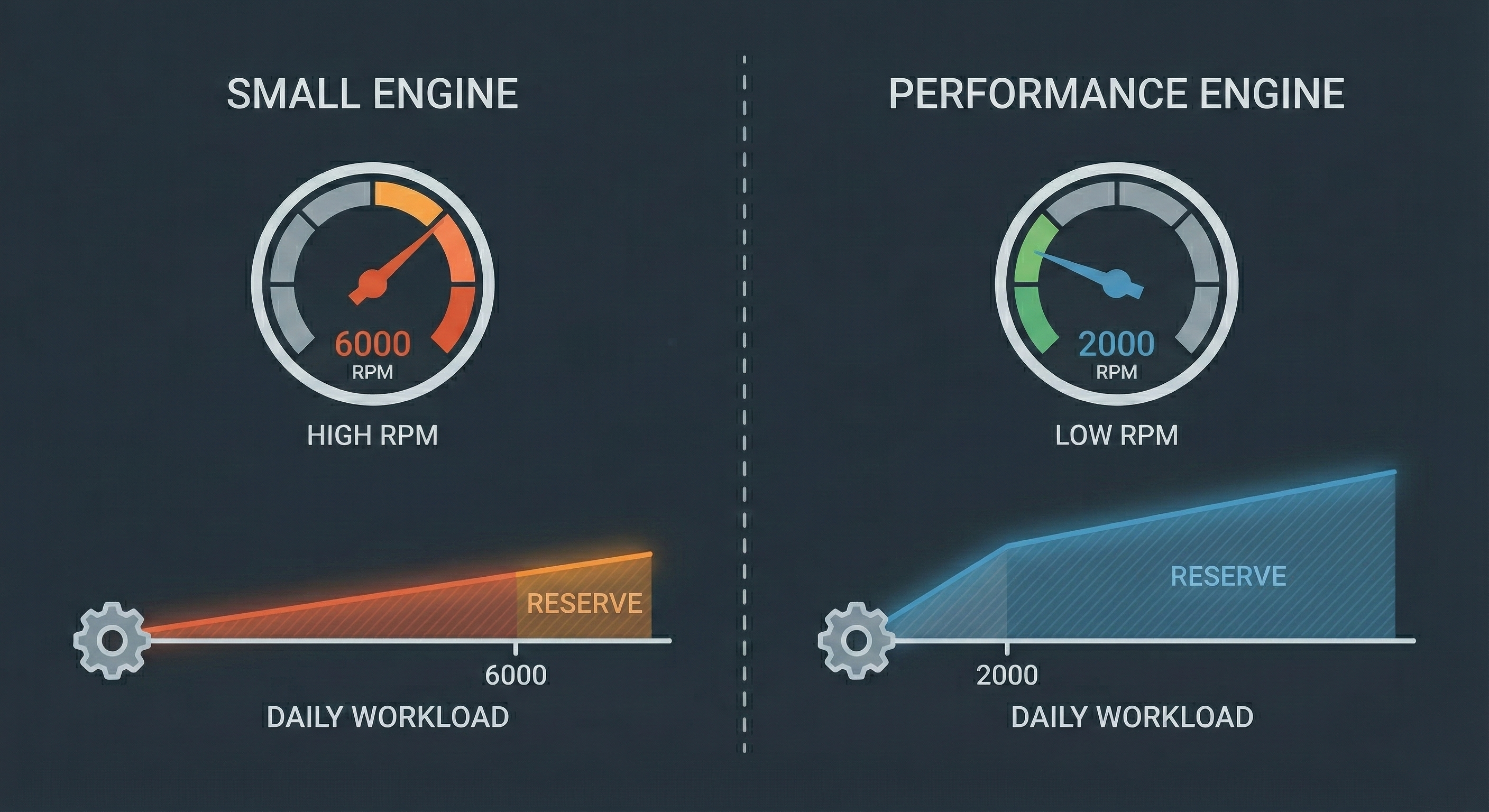
Technically, VO2Max measures the maximum amount of oxygen your body can use in one minute. Practically, think of it as the size of your engine.
- Small Engine (Low VO2Max): To maintain a highway speed (your daily workload), a small engine has to rev at 6,000 RPM. It’s loud, inefficient, and wears out quickly.
- Big Engine (High VO2Max): A performance engine cruises at the same speed at 2,000 RPM. It is silent, efficient, and has plenty of power in reserve for passing on hills.3
Upgrading your VO2Max means everyday tasks—carrying luggage, rushing to a gate, or managing a crisis—stop feeling like maximum efforts. Your heart rate stays lower, and you stay cooler under pressure.4
2. Why You Should Care: The "Functional Reserve"
The most compelling reason to track this isn't to become an athlete; it is to ensure you maintain your independence as you age.
The Mortality Data
A landmark study of 122,000 people found that elite cardiorespiratory fitness was associated with an 80% reduction in mortality risk compared to low fitness.
Being unfit carries a higher statistical risk of death than smoking, diabetes, or heart disease.
No Upper Limit: The data shows that "more is better." There is no point where getting fitter stops being beneficial.
The Slope of Decline
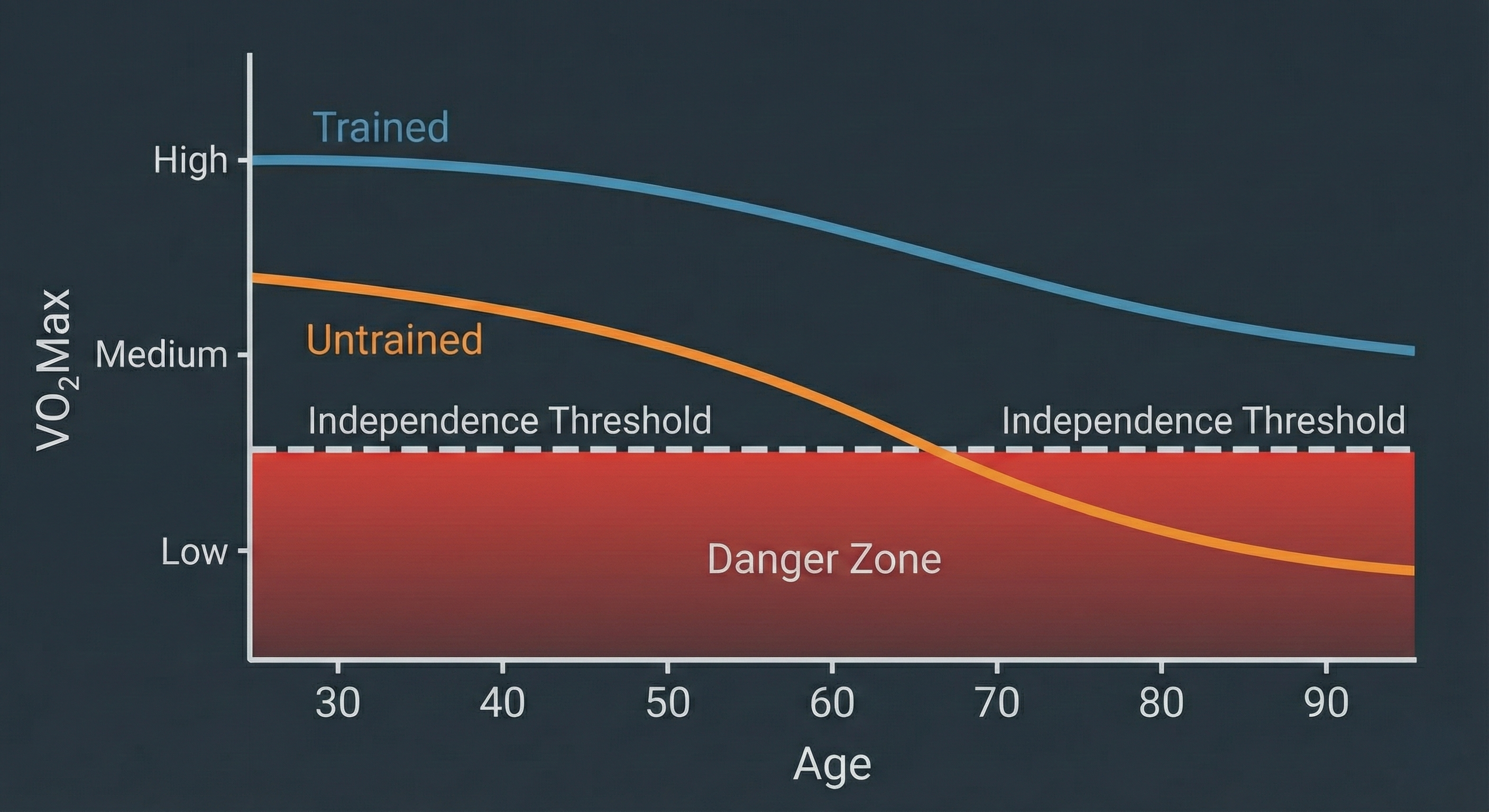
Every decade after age 30, your VO2Max naturally drops by about 10%. This is the "slope" of aging.
The Danger Zone: There is a specific threshold of fitness required for independence (e.g., climbing stairs requires a VO2Max of roughly 20-25 mL/kg/min).
The Safety Margin: If you are "average" now, the natural decline will drag you below that independence threshold in your 70s or 80s. By building a high VO2Max now, you create a Functional Reserve—a large gap between your capacity and the threshold of frailty. This ensures you can still hike, travel, and live freely well into your 90s.
3. The Executive Edge: Cognitive Stamina
VO2Max isn't just for the future; it’s a performance tool for today.
Stable Energy: Unfit bodies rely heavily on sugar for fuel, leading to blood glucose spikes and the dreaded 3:00 PM slump. A high VO2Max improves your body's ability to burn fat, providing a stable, long-lasting fuel source for the brain.
Stress Resilience: High-intensity aerobic exercise mimics the physical symptoms of stress (high heart rate, cortisol spike). Regular training teaches your body to recover from this state quickly. Fit individuals see their stress hormones return to baseline much faster after a tense event than unfit individuals.
4. How to Measure It (Without a Lab)
The most accurate way to measure VO2Max is in a lab (Indirect Calorimetry), but your smartwatch is a useful tool if you use it correctly.5
The Accuracy Trap
Smartwatches estimate VO2Max by analyzing the relationship between your Heart Rate and your walking/running speed.
The Problem: If you only track indoor workouts (like yoga or treadmill runs), the watch lacks the GPS data needed to make a good calculation.
The Fix: Once a month, do a "calibration session." Go to a flat outdoor track or road. Record an "Outdoor Run" or "Outdoor Walk" for 20 minutes at a challenging, steady pace. This gives the algorithm the clean data it needs to update your score accurately.
5. The "Minimum Effective Dose" Training Plan
You don't need to train like a marathon runner. You need a mix of Zone 2 (low intensity) and HIIT (high intensity).
The Protocol: Norwegian 4x4
This is widely considered the most time-efficient protocol for boosting VO2Max.
Frequency: 1-2 times per week. Total Time: ~40 minutes. The Workout:
- Warm-up: 10 mins (easy jog/cycle).
- Interval: 4 minutes hard (85-95% max effort). You should be breathing too hard to speak more than a few words.
- Recovery: 3 minutes easy.
- Repeat: Do 4 intervals total.
- Cool down: 5 minutes.
The "No Time" Emergency Option: REHIT
If you cannot find 40 minutes, use REHIT (Reduced-Exertion HIIT). It provides significant benefits in just 10 minutes.
The Workout:
- Warm-up (2 mins).
- Sprint: 20 seconds of pure, 100% max effort.
- Recover (3 mins very easy).
- Sprint: 20 seconds of pure, 100% max effort.
- Cool down (3 mins).6
6. Your Goal: The Centenarian Decathlon
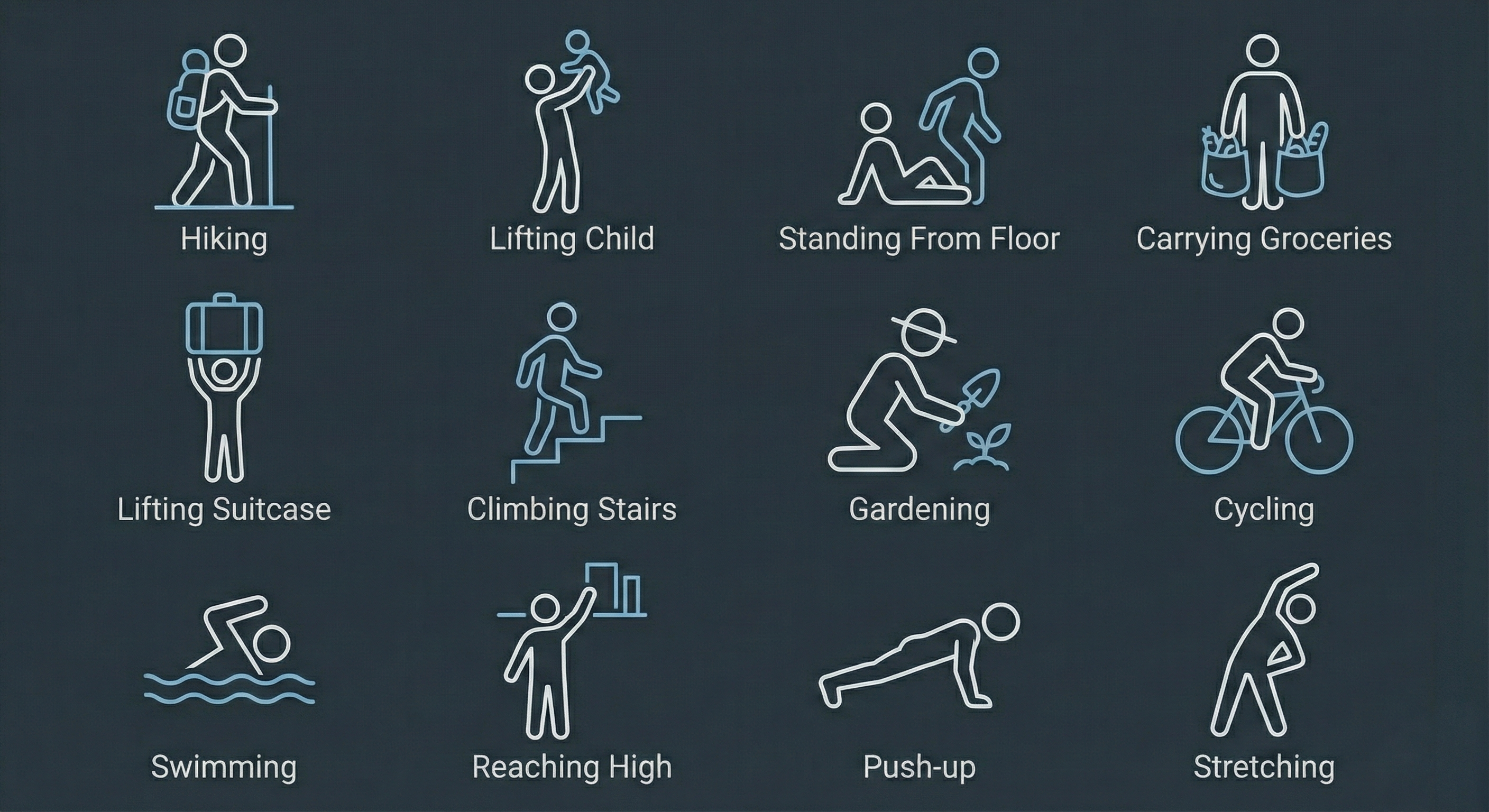
Dr. Peter Attia suggests setting your goals based on what you want to do in your final decade of life. He calls this the Centenarian Decathlon. Pick 10 physical tasks you want to be able to do at age 90, and train for them now.
Examples:
- Hike 1.5 miles on a hilly trail.
- Pick up a 30-pound grandchild.
- Get up off the floor using only one arm.
- Carry two grocery bags for five blocks.
- Lift a 20-pound suitcase into an overhead compartment.
To perform these tasks at 90, you must be significantly fitter today to account for the natural decline.
Appendix: The Physiology (For the Curious)
For those who want the math, VO2Max is determined by the Fick Equation:
(Cardiac Output): The volume of blood your heart pumps per minute. This is improved by High Intensity training (like the 4x4), which forces the heart chamber to stretch and pump more blood per beat (Stroke Volume).6
(Oxygen Extraction): How efficiently your muscles pull oxygen out of the blood. This is improved by Zone 2 (long, slow) training, which increases the number of mitochondria and capillaries in your muscle tissue.8
Summary: High intensity builds the "pump" (Heart). Low intensity builds the "efficiency" (Muscles). A complete program needs both.
References
Mortality & Longevity
Mandsager K, et al. (2018) — JAMA Network Open
- Large clinical cohort study linking treadmill-measured cardiorespiratory fitness to long-term all-cause mortality.
- Found a strong, graded relationship: higher fitness = lower mortality risk.
- Notably, “elite” fitness showed dramatically lower mortality risk vs. low fitness, and the benefit did not appear to plateau at the top end (i.e., more fitness kept helping).
- Practical implication for your post: VO2Max/cardiorespiratory fitness functions like a global health risk reducer, not just an “athlete metric.”
Kokkinos P, et al. (2022) — Journal of the American College of Cardiology
- Examined mortality risk across broad demographics (age, race, sex) using cardiorespiratory fitness as the predictor.
- Reported a consistent “dose-response” effect: each +1 MET increase in fitness is associated with a meaningful reduction in mortality risk (commonly translated as ~3.5 mL/kg/min VO2Max per MET).
- Practical implication: even modest improvements in VO2Max can translate into measurable longevity benefits—useful for motivating “minimum effective dose” training.
Training Protocols (HIIT & Zone 2)
Helgerud J, et al. (2007) — Medicine & Science in Sports & Exercise
- Compared high-intensity interval training vs. moderate continuous training for improving VO2Max and related cardiovascular adaptations.
- Helped popularize the Norwegian 4x4 structure (work bouts at very high effort relative to max heart rate) as especially effective for VO2Max improvement.
- Practical implication: supports your claim that time-efficient HIIT can outperform “always moderate” training for raising VO2Max.
Metcalfe RS, et al. (2024, review) — Applied Physiology, Nutrition, and Metabolism
- Synthesized evidence on REHIT (Reduced-Exertion HIIT), typically featuring very short all-out sprints inside a brief session.
- Concludes that extremely low-volume sprint-based training can still drive meaningful physiological adaptation in many people (particularly time-constrained, non-elite populations).
- Practical implication: backs your “10-minute emergency option” as a credible fallback when schedule is tight.
San Millán I, et al. (various) — Metabolic flexibility / mitochondrial bioenergetics
- Focuses on how aerobic metabolism, lactate dynamics, and mitochondrial function relate to performance and health.
- Emphasizes Zone 2 work as foundational for improving mitochondrial efficiency, fat oxidation capacity, and lactate clearance/handling.
- Practical implication: supports your “two-part engine upgrade” framing—Zone 2 builds metabolic efficiency that complements VO2Max-focused intervals.
Cognitive Function & Neurobiology
Erickson KI, et al. (2011) — PNAS
- Investigated how aerobic exercise training affects brain structure and memory in older adults.
- Found that aerobic training can increase (or preserve) hippocampal volume, a region crucial for memory, alongside memory improvements.
- Practical implication: strengthens your “VO2Max isn’t just physical—it supports brain health and cognition” section with a concrete neural mechanism.
Sothmann MS, et al. — Cortisol stress responses
- Explores the relationship between aerobic fitness and stress physiology (HPA-axis/cortisol) during demanding tasks.
- Suggests higher aerobic fitness is associated with a more efficient stress response and/or faster recovery after acute stressors.
- Practical implication: reinforces your “stress resilience” claim—fitness can improve how quickly you return to baseline after high-pressure events.
Measurement & Technology
Lambe et al. (2023/2025) — Validation of Apple Watch VO2Max estimates
- Evaluates how well smartwatch-estimated VO2Max aligns with criterion measures (e.g., lab testing) across different populations.
- Highlights common real-world issues: estimates can vary by context, may underestimate at higher fitness levels, and benefit from correct use (including outdoor GPS-linked sessions when required by the device algorithm).
- Practical implication: supports your “smartwatch is useful if you calibrate it correctly” guidance—especially the outdoor steady-effort sessions.
Concepts & Frameworks
Attia, Peter (2023) — Outlive: The Science and Art of Longevity
- Proposes “backcasting” fitness: define what you want to be able to do in your final decade, then train now to preserve that capability.
- Introduces the Centenarian Decathlon as a practical framework for choosing meaningful, functional goals (strength, endurance, mobility).
- Practical implication: gives your post a memorable goal-setting wrapper that turns VO2Max training into life capability planning, not vanity metrics.